


Things to Do in Aveiro, Portugal: The Ultimate Active Traveller's Guide (2026)
Aveiro is one of those places that keeps surprising you. The art nouveau architecture is more extraordinary than the photos suggest. The lagoon is bigger and wilder than you expect. And tucked between the canals and the Atlantic coast is one of the best watersports setups in mainland Europe, which almost nobody writes about. This guide covers all of it.
Section 01
Explore Aveiro's Famous Canals by Moliceiro Boat
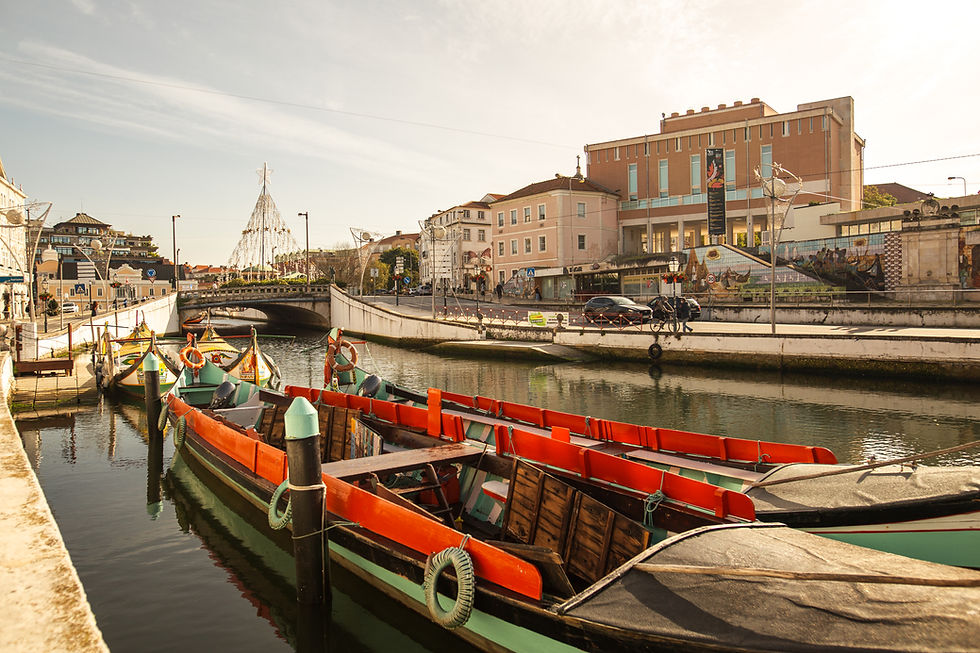
People call Aveiro the Venice of Portugal, which sets up expectations that the city can't quite meet, and doesn't need to. What you actually find is a compact, beautiful old town where a handful of wide canals cut through art nouveau streets and painted boats drift past facades in shades of yellow, blue and white. It's lovely on its own terms. Give it the chance to be that.
What is a Moliceiro and why should you ride one?
A moliceiro is a flat-bottomed wooden boat, traditionally used to harvest moliço: aquatic plants collected from the lagoon and spread across farmland as fertiliser. The boats are wide, sturdy, and decorated with hand-painted panels that mix religious scenes, folk humour and the occasional image you wouldn't put on a postcard. Check the prow carefully before you board. Some of them are quite something.
A tour runs 45 minutes. You'll drift past ornate bridges, art nouveau houses, and out toward the salt flats at the lagoon's edge. It's the right way to arrive in Aveiro: slow, at water level, with someone who knows the city talking you through what you're looking at. The friendship-ribbon bridges are worth noticing too: a university student tradition where the city's canal bridges are covered in colourful named ribbons tied by couples and friends. Free ribbons are in boxes at each bridge if you want to leave one.
Tour tips — best time, cost, and what to expect
Tickets are around €12–15 per adult. Multiple operators depart from Cais dos Moliceiros near Rua João Mendonça, no booking needed, just turn up. The last departure of the day is the best one. The crowds have thinned, the heat has dropped, and the light over the canal in the late afternoon is very good. Avoid midday in July and August if you can, the boats are fully open and the sun is unforgiving. Bring sunscreen regardless.
Explore the canals by free BUGA bike instead
Aveiro has a free bike scheme — the BUGA — and it's genuinely one of the best things about the city. Collect a bike at the Loja BUGA in the Manuel Firmino Market with a valid ID and borrow it for up to two hours at no cost. The city is flat, the canal-side paths are well maintained, and the route that runs out along the lagoon toward the salt pans and Costa Nova is worth every minute of it. Some mornings, on the water, the light is extraordinary.
Section 02
Costa Nova: Stripes, Beaches, and the Tallest Lighthouse in Portugal
About 11 kilometres southwest of the city, where the lagoon opens out into the Atlantic, Costa Nova is one of the most photographed villages in Portugal. It deserves it. But most people take the photos and leave, which means they miss a very good beach, a proper fish market, and one of the tallest lighthouses on the Iberian Peninsula, all within a kilometre of each other.
The iconic colourful striped houses

The palheiros lining Costa Nova's main street are fishermen's storehouses, painted in tall vertical stripes of red, green, blue and yellow. They were built for storing equipment rather than for decoration, the colours apparently helped fishermen identify their own from a distance at sea. Whatever the origin, the effect is striking. Go early in the morning before the tour coaches arrive from Porto, when the light is angled and the street is quiet enough to properly look. The fish market around the corner is worth a browse if you're there before noon.
Praia de Costa Nova — swimming, sun, and Atlantic waves
Behind the village is a wide Atlantic beach backed by high dunes, with waves consistent enough for surfing and water warm enough for swimming from late spring. It gets busy in summer, extremely so in August, but a May, June or September visit is excellent. The seafood restaurants along the seafront are worth staying for lunch. Order whatever came in that morning and you won't go wrong.
Barra Lighthouse — can you go inside?
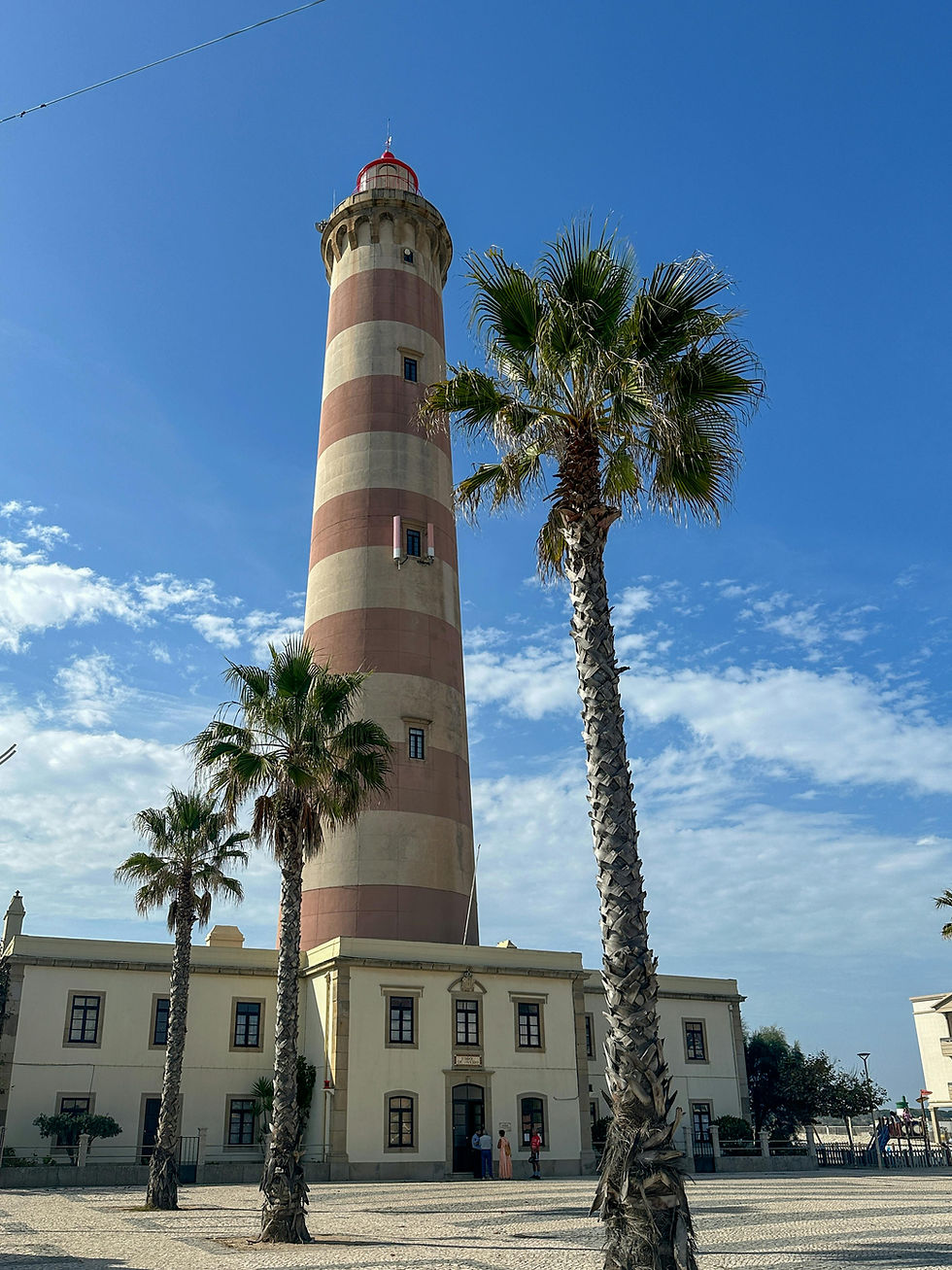
A kilometre north along the coast road at Praia da Barra, the Farol da Barra has stood since 1893: 62 metres of red and white striped tower built to guide ships through the shallow Ria de Aveiro inlet. You can go inside, but only on Wednesdays. Visits run 14:00 –17:00 in summer (13:30 –16:30 in winter), admission is free, no tickets required. Climb 271 stone steps plus 20 metal ones to reach the viewing gallery at the top. The panorama up there: lagoon behind you, open Atlantic ahead, Costa Nova stretching south, is worth every step of it.
Section 03 · The differentiator no competitor covers
Watersports on the Ria de Aveiro — The Active Traveller's Playground
Most Aveiro guides stop at the canals. What they don't cover is this: within two kilometres of each other, you have one of the best flatwater lagoons in Europe for learning watersports, and a consistent Atlantic beach break. That combination is rare. It's the reason serious active travellers should be planning a full week here, not a day trip.
Kitesurfing on the Ria de Aveiro — one of Europe's best spots

The wind that makes this place work is the Nortada: a northerly thermal that builds off the Atlantic and blows reliably from May to September, typically 15 to 30 knots. The Ria de Aveiro lagoon behind Praia da Barra is sheltered from ocean swell, with a sandy bottom and wide sections of waist-deep water. For beginners, those two things matter enormously: when something goes wrong, you can stand up. The flat water lets you focus on learning without fighting waves. For experienced riders, the open lagoon gives space for speed runs and tricks; the Costa Nova side runs windier and suits those who want to push harder.
Water temperature reaches around 22°C in summer, 15°C in winter. A wetsuit is sensible year-round for anything longer than a short session.
Surfing at Praia da Barra
Praia da Barra is a long, wide Atlantic beach just north of the Ria inlet, backed by dunes and exposed to consistent swell. The break suits beginners and intermediates well: waves are generally clean, the beach is generous, and it's considerably less crowded than the surf spots further south that everyone has already heard of. Good waves most days from autumn through spring; in summer the swell quietens but the water is warm and the conditions work well for lessons and longer, unhurried sessions.
Wing foiling, SUP, e-foil, and more
Flat water and steady wind make the Ria one of Portugal's best spots to learn wing foiling: a sport that usually demands strong water skills but is unusually approachable here, where the conditions give you time and space to figure it out. Stand-up paddleboarding on the lagoon is quieter: a good way to explore the network of channels and salt pans at your own pace, particularly in the early morning when the water is glassy. E-foiling: electric hydrofoil boarding, is something else entirely. No wind, no sound, just gliding silently above flat water. It's one of those experiences that's difficult to explain beforehand and immediately obvious once you're on it. Tubing behind a boat is the option for anyone who wants to be thrown around on the water and has no interest in learning a new skill first.
How to book lessons and rentals at MyWay Kite & Surf
At Forte da Barra, sitting between the lagoon and the ocean beach, MyWay Kite & Surf is the watersports school and base for the area. Kitesurfing from beginner to advanced, surf lessons, wing foiling courses, SUP rentals, e-foil sessions, tubing. Instructors are IKO-certified, multilingual, and good at reading conditions to put you in the right place on any given day.
The lagoon launch is a three-minute walk from the school. The ocean beach is five minutes. Whatever the conditions call for, you're already there. MyWay also runs a hotel and bar on site: accommodation, instruction, gear and food all from the same base, with no car needed.
How to book: visit myway-kitesurf.com to check the course calendar and availability. Beginner spots fill fast between June and September: book before you arrive.
Section 04
History and Culture in the City Centre
Aveiro's city centre rewards slow walking. Give it at least half a day, more if you're interested in architecture, because there is more good art nouveau on these streets than almost anywhere in Portugal, and most visitors walk straight past it looking for the canal.
Museu de Aveiro / Santa Joana Convent
The most important museum in Aveiro is housed in the former Convent of Jesus: a 15th-century Dominican convent where Princess Joanna of Portugal spent most of her adult life, having chosen the convent over a succession of royal marriages offered to her. The collection includes exceptional religious art, carved altarpieces, and azulejo tilework throughout, but the centrepiece is the marble Baroque tomb built for Princess Joanna that alone is worth the visit. It is a beautiful building with a serious collection. Not a dusty local curiosity. Open Tuesday–Sunday, 10:00–12:30 and 13:30–18:00. Closed on major public holidays. Address: Avenida de Santa Joana.

Art Nouveau architecture — a self-guided walking tour
Aveiro is one of the best places in the world to see art nouveau applied to everyday urban buildings rather than grand civic ones. The story is a good one: at the turn of the 20th century, emigrants who had made fortunes in Brazil returned to Aveiro and hired architects working at the height of the international art nouveau movement. The results: extravagant, tile-clad, wrought-iron-draped facades still lining the main canal, are unlike anything in Porto or Lisbon. Every town in Portugal has its azulejos. Aveiro's are different.
Start on Rua João Mendonça along the canal for the most eye-catching facades, then find Casa da Silva Rocha on Rua do Carmo: arguably the finest single building. The Museu de Arte Nova runs a self-guided art nouveau route with audiovisual material, and its on-site Tea House is one of the best spots in Aveiro for coffee. It becomes a live-music bar on weekend evenings. There are 28 documented art nouveau buildings in the city; the tourist office near the train station gives out a printed walking map for free.
Aveiro Cathedral and Igreja da Misericórdia
The Sé Cathedral was originally a Dominican convent from the 15th century, with subsequent Gothic and Baroque additions. It's directly across from the Museu de Aveiro and worth a brief visit. A short walk away, the Igreja da Misericórdia on Rua Direita has one of the most impressive azulejo-tile facades in the city: an entire front wall in ornate blue-and-white tiles that is very easy to walk past if you're not specifically looking for it. Look for it.

Section 05
Food, Sweets, and the Local Market
Aveiro eats well. The lagoon and the Atlantic supply some of the freshest seafood in Portugal, and the city's convent-pastry tradition produces one of the country's most distinctive and genuinely delicious sweet treats. Don't leave without eating both.
Ovos moles — what they are and where to find the best ones
Every town in Portugal has its egg-based convent sweet. Aveiro's is ovos moles: a golden, creamy yolk-and-sugar filling pressed inside thin rice paper wafers, shaped into clams, seashells, fish and barrels. The recipe came from the city's Dominican convents, where nuns were left with enormous quantities of egg yolks after whites were used to clarify wine and starch linens. Simple, rich, and completely addictive: they now carry EU Protected Geographical Indication status, the first Portuguese pastry product to receive it.
They are intensely sweet and very rich; one or two with an espresso is exactly the right amount. The oldest and best shop is Confeitaria Peixinho (founded 1856, just off the main canal), also try their raivas, the crisp almond biscuits that nobody seems to mention but that are equally good. For a more hands-on experience, Oficina do Doce runs sessions where you can watch the process and try making your own.

Mercado Manuel Firmino — fresh seafood and local produce
Aveiro's main covered market is where the city actually shops. The fish section in the mornings is excellent: if you're self-catering, this is where to buy the day's catch. It also sells locally produced salt and flor de sal at a fraction of the tourist-shop price, which makes for a better souvenir than most things you'll find near the canal. The BUGA bike station is here too, so you'll likely pass through anyway.
For lunch, the Mercado do Peixe near the São Roque canal is the local favourite: working fish market in the mornings, upstairs restaurant at lunchtime, daily catch specials with zero ceremony and excellent value, typically €8–12 for a full meal. Closed Sundays.
Best restaurants in Aveiro for fresh fish
The best eating is concentrated around Praça do Peixe: a lively square lined with restaurants and bars that fills up as the evening goes on and is the right place to end any city day. Order the caldeirada de enguias (eel stew) if you want something genuinely specific to Aveiro. Arroz de marisco (seafood rice) and feijoada de búzios (bean stew with sea snails) are also regional signatures worth seeking out. Seafood rice for two typically runs €25–35 at a mid-range restaurant on the square.

Section 06
Hidden Gems and Day Trips from Aveiro
Aveiro is positioned unusually well for day trips: close to mountains, wild rivers, big-wave beaches, and artisan factories that most visitors to Portugal never find. These are the ones worth rearranging your schedule for.
The Arouca 516 Suspension Bridge (world's longest pedestrian suspension bridge)

About 60 kilometres southeast of Aveiro, the Arouca 516 bridge spans 516 metres across the Paiva River gorge, suspended 175 metres above the water. The floor is a transparent metallic grid: you look straight down into the gorge below with every step. I am not going to oversell it: it is one of the most exhilarating things you can do in Portugal on a clear day, and the combination with the Passadiços do Paiva riverside walkways below makes for a genuinely extraordinary full day out.
The Passadiços do Paiva run for 8 kilometres of wooden walkways along the wild Paiva riverbank through the Arouca UNESCO Geopark: the full day takes 6–8 hours. Critical: tickets must be purchased online in advance at 516arouca.pt. They are not sold at the entrance and sell out weeks ahead in summer. No public transport to the site: you need a car or a guided tour.
Vista Alegre Porcelain Factory in Ílhavo
Just 12 kilometres south of Aveiro in Ílhavo, Vista Alegre has been producing fine Portuguese porcelain since 1824. The factory museum covers the full history: from royal commissions to the hand-painted pieces still made by hand today, and the shop sells factory-outlet pieces at reduced prices. If you're interested in ceramics at all, this is the place in Portugal. Combine it with the Museu Marítimo de Ílhavo next door, which tells Aveiro's extraordinary story of cod fishing on the Grand Banks of Newfoundland, complete with a restored trawler you can board. Allow 3–4 hours for both; close enough to Aveiro to combine easily with a half-day in the city.
Nazaré — see the big wave capital of the world (1 hour south)
About 100 kilometres south of Aveiro, Nazaré produces the largest surfable waves in the world. The Nazaré Canyon, an underwater gorge running from the deep Atlantic directly into the bay, funnels swells that can exceed 20 metres in winter. In season (October–March), you can watch tow-in surfers ride walls of water from the cliff viewpoint at Praia do Norte: one of the most extraordinary things you can witness in Portuguese sport. In summer the same beach is calm enough for swimming, and the fishing village behind it has excellent sardine restaurants. Drive the A17 coastal motorway south; allow 1h15 from Aveiro.


Salt pan mud spa at Ria de Aveiro
One of Aveiro's most unusual and genuinely memorable experiences: a salt pan mud bath at one of the working salines on the Ria. The Cale do Oiro Spa Salínico runs seasonal sessions (July–October) in an open-air salt pool where the natural bottom mud is scooped onto your skin, dried in the sun, and rinsed off in highly saline water that lets you float effortlessly, similar to the Dead Sea effect. The setting is pure Ria: open salt flats, lagoon views, birdsong. Prices run around €4–7. Aveiro Emotions also runs salt spa experiences at Marinha da Noeirinha, with guided tours of the salt pans available year-round.
Section 07
How to Get to Aveiro and Getting Around
Train from Porto (1h15, ~€4) and from Lisbon (2.5h)
The easiest way to reach Aveiro is by train. From Porto Campanhã, trains run roughly every 30–60 minutes throughout the day; the journey takes approximately 1 hour 15 minutes and tickets cost around €3.50–5 one-way. From Lisbon Santa Apolónia, the Alfa Pendular fast train takes approximately 2.5 hours. Tickets can be booked in advance via cp.pt or the CP app. Aveiro's station sits in the city centre, 10 minutes' walk from the main canal, and the station itself is worth stopping for, with tile panels from 1916 depicting the landscapes of the whole region. It is a good introduction to the city.
The nearest international airport is Porto Francisco Sá Carneiro Airport. By car from the airport, allow 40–50 minutes south via the A1 motorway.
Getting around by bike, foot, and boat
The city centre is compact and flat: most attractions are within 20 minutes on foot of the station. The free BUGA bike scheme at the Manuel Firmino Market (bring ID; free for 2 hours) is the best way to explore beyond the centre. For getting to Praia da Barra and Forte da Barra, 11 km from the city, a car or taxi (Bolt operates in Aveiro) is the most practical option. If you're staying at MyWay, they can advise on arrival logistics for your specific situation.
Where to stay — hotels, van life, and surf camps near Aveiro
Where you stay depends entirely on what kind of trip you're planning. City-centre hotels put you near the canals and culture; beach-based accommodation at Forte da Barra gives you immediate water access, which is essential if watersports are the main reason you've come.
Section 08
FAQ — Aveiro Portugal
Is Aveiro worth visiting?
Yes, and it's more than a day trip from Porto, though it works well as one. The canals and Art Nouveau are genuinely beautiful, the food is excellent, and the combination of lagoon and Atlantic coast makes it one of the best watersports bases in mainland Portugal. If all you want is the canals and the ovos moles, a day is enough. If you want to kitesurf, surf, or wing foil, Aveiro deserves at least three nights, and if you've never tried any of those things, the Ria is one of the best places in Europe to start.
How many days do you need in Aveiro?
One full day covers the city-centre highlights: a moliceiro boat tour, the Art Nouveau walking route, the Museu de Aveiro, and a meal on Praça do Peixe. Add a second day for Costa Nova, the lighthouse, and the salt pans. If you want watersports or the Arouca day trip, three to five days is right. For a dedicated kitesurf or surf camp with MyWay, a full week is the standard booking, and it goes quickly.
What is Aveiro famous for?
Aveiro is most famous for its canals and moliceiro boats (hence the Venice of Portugal nickname, not entirely accurate, but not entirely wrong either), its Art Nouveau architecture, and its ovos moles pastries. Beyond those, it's known for its historic salt production, the striped palheiro houses at Costa Nova, and, among active travellers, as one of Europe's best kitesurfing and wing foiling destinations thanks to the flat Ria de Aveiro lagoon and the reliable Nortada thermal wind.
When is the best time to visit Aveiro?
For city exploration, May–June and September–October offer the best combination of warm weather, smaller crowds, and open attractions. For watersports, the prime window is May through September, when the Nortada is most reliable and water temperatures reach 20–22°C. August is peak season: crowded, hot, more expensive, but lively and well-provisioned if that's what you're after. The salt pan spa experience is seasonal (July–October). Winter visits are quiet and mild, though some seasonal beach businesses close from October onwards.


Comments